
The Manmohan Singh government's rush to pass the Food Security Bill reflects extreme paucity of logic and action, says Neeta Kolhatkar

A US national was arrested in Maharajganj, Uttar Pradesh, while allegedly attempting to cross illegally into Nepal. The individual, identified as Phelan Travis Anthony, had overstayed his visa in India and was trying to evade legal proceedings.

Opposition leaders have criticised Prime Minister Narendra Modi's address to the nation, calling it politically motivated and a misuse of official platforms during ongoing elections.
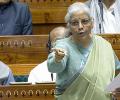
Finance Minister Nirmala Sitharaman launched a strong attack on Rahul Gandhi and the Congress party, accusing them of compromising India's interests on the world stage and selling out farmers and the poor during their time in power.

With hardly anything positive to flaunt before the electorate while seeking a third consecutive term at the Centre, Sonia Gandhi's Congress is desperately hoping that the food security law will help it win the support of the people much like the national rural employment guarantee or the right to information acts or the farm loan waivers had done for it in the 2009 Lok Sabha polls, says Saroj Negi

From marocain to bromocriptine, the Scripps National Spelling Bee has challenged young wordsmiths with some of the English language's most obscure and fascinating words over the past decade.

The finance ministry has clarified that its letter to state chief secretaries, urging them to align their bonus policy to promote pulses, oilseeds, and millets, was an advisory and not a directive. This clarification comes in response to Tamil Nadu Chief Minister M K Stalin's criticism, who called the advisory a 'treacherous act against farmers'.

The United States and India are on the verge of finalising a landmark bilateral trade deal, aiming to boost trade to USD 500 billion by 2030, according to US Deputy Assistant Secretary of State Bethany Poulos Morrison. The agreement seeks to open India's 1.4 billion-strong market to American goods on reciprocal terms, with ongoing high-level discussions to recalibrate the pact after recent changes in US tariff policy.
India and the United States have reviewed progress on a proposed interim bilateral trade agreement, discussing market access, digital trade, and non-tariff barriers, as they race to finalise a deal before a temporary 10 per cent US tariff regime expires on July 24.

While the Andaman and Nicobar islands serve as a vital, stationary asset for projecting power in the Indian Ocean, referring to them as an unsinkable aircraft carrier ignores key military and geopolitical limitations, explains Commodore Venugopal Menon (retd).

This comes a day after President Droupadi Murmu gave her assent to the Viksit Bharat Guarantee for Rozgar and Ajeevika Mission (Gramin) (VB-G RAM G) Bill, which replaces the MGNREGA and has a provision for 125 days of wage employment for rural workers.

Under the defence partnership, India and the UAE are eyeing defence industrial collaboration and cooperation in advanced technologies, cyberspace training, special operations, interoperability of their militaries and counter terrorism.

India has strongly condemned Pakistan's airstrikes on Afghanistan, calling them a flagrant violation of international law and hypocritical given the civilian casualties during Ramzan.

Punjab Chief Minister Bhagwant Mann has invited Dutch hockey legend Floris Jan Bovelander to help strengthen hockey in the state, particularly ahead of the Asian Champions Trophy. Mann emphasised the government's commitment to restoring the sport's glory and highlighted Punjab's rich hockey legacy.

West Bengal Chief Minister Mamata Banerjee and her nephew Abhishek Banerjee will hold a virtual meeting with TMC counting agents to prepare for the vote counting of the assembly elections.

Prime Minister Narendra Modi convened the Cabinet Committee on Security to address the impact of the West Asia conflict on Indian citizens, focusing on safeguarding them from the conflict's effects and ensuring the smooth flow of essential supplies.

BJP MP Anurag Thakur believes PM Modi's purchase of 'jhalmuri' in Jhargram will influence the West Bengal Assembly polls, contrasting it with CM Mamata Banerjee's actions. He also criticised the TMC government for blocking central schemes and failing to ensure women's safety.

Dismissing the talk about early elections, the Congress said the food security measure is a game changer that will provide right to cheap food grains to 82 crore people.

India has completely protected the interests of its agriculture and dairy sector in the India-US trade agreement.

If TVK MLAs and ministers are perceived as clean, or demonstrably cleaner than their predecessors, the credibility dividend will be enormous. The voter will feel rewarded, points out Ramesh Menon.
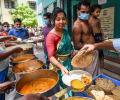
5-kg free food grains per person per month would be given to around 80 crore people for the two months.

'In West Bengal, the BJP's ideology of Hindutva will be customised to cater to the culture and the cultural imperatives of Bengalis.'

Sacred spots and soaring peaks: Bucket-listing across the heartland. Roopa Unnikrishnan and her father journey through the heart of India.

The US blockade on Iranian ports is aimed to curb Iranian energy exports, thereby crippling its economy to force Iran back to the negotiating table, points out Commodore Venugopal Menon (retd).
India told the UN Security Council that it calls for a pragmatic engagement with the Taliban, underlining that a focus on only punitive measures will ensure a 'business as usual' approach.
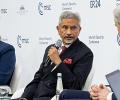
India's External Affairs Minister S Jaishankar countered a US senator's claim that democracy does not put food on the table, citing India's PMGKAY program which provides food to 800 million people. Jaishankar argued that different parts of the world have different experiences with democracy and that the model of globalization has contributed to issues with democracy in some regions. He emphasized that India's democratic system effectively delivers food security, highlighting the PMGKAY program as an example.

'The West Asia or the Gulf crisis has shown that what we develop as national infrastructure when things are not as bad as they could be, we forget to plan for adversities.'

A BJP government in Bengal inherits more problems than it might care to admit at its moment of triumph, points out Ramesh Menon
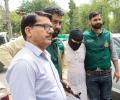
Delhi Police have arrested a suspected Lashkar-e-Taiba (LeT) handler, Shabir Ahmed Lone, in Delhi, uncovering a terror module with links to Pakistan's ISI. Lone is accused of running a network involved in pasting anti-national posters and planning terror activities across India.

The BRICS nations have expressed concern over the proliferation of trade-restrictive actions in the form of 'indiscriminate rising' of tariffs, particularly measures used as a means of 'coercion', cautioning that such practices risk marginalising the Global South countries.

The Supreme Court has expressed serious concern over the 'hostage' situation involving seven judicial officials in West Bengal's Malda district, demanding explanations from state officials and authorising the Election Commission to seek a CBI or NIA probe.

India and the United States are committed to finalising an interim trade agreement, despite recent challenges including the US imposing a blanket 10 per cent surcharge and India's decision to wait for a new global tariff architecture. The US Trade Representative's annual report highlights India's maintained high import tariffs and various non-tariff barriers across several sectors.

The government is likely to give a legal right to food to both priority and general categories of the population under the proposed National Food Security Act, as suggested by the Sonia Gandhi-led National Advisory Council (NAC).

Union Home Minister Amit Shah criticised the Congress party for its alleged inaction in addressing Maoist violence during its long rule, while highlighting the Modi government's success in nearly eradicating Maoists from Bastar, Chhattisgarh.

When everyone has footage and no one can verify it, the loudest voice wins, notes Prem Panicker who begins a daily blog on the War in the Middle East.
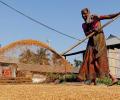
Stating that the food subsidy bill is becoming "unmanageably large", the Economic Survey 2021 on Friday suggested the government to increase the selling price of foodgrains provided through ration shops to over 80 crore beneficiaries. Foodgrains via ration shops are supplied at highly subsidised rates of Rs 3 per kg for rice, Rs 2 per kg for wheat and Rs 1 per kg for coarse grains through Public Distribution System (PDS) as per the National Food Security Act (NFSA). "While it is difficult to reduce the economic cost of food management in view of rising commitment towards food security, there is a need to consider the revision of central issue price (CIP) to reduce the bulging food subsidy bill," the survey said.

Alliances fight wars effectively only when they share an endgame. If Israel acted without US knowledge, then the military alliance is operating without real coordination at the level of strategic targeting. Neither picture is reassuring in a war that is no longer regional in its consequences. Prem Panicker continues his must read daily blog on the Gulf War.

Trump may strike. He may announce productive talks and extend again. He may do both at the same time. Iran will not open the Strait on someone else's terms, so no matter what happens, that problem will remain unsolved. And the IRGC will still be collecting its $2 million toll from every ship bold enough to ask permission to pass.

Prime Minister Narendra Modi inaugurated the Northeast's first Emergency Landing Facility in Assam, boosting regional defense and disaster response capabilities.

The Supreme Court of India expressed concerns about the long-term sustainability of providing free rations to migrant workers, emphasizing the need for job creation and capacity building instead. The court's remarks came during a hearing on the ongoing issue of providing relief to migrant workers, a matter that gained prominence during the COVID-19 pandemic. The court questioned the government's reliance on freebies and stressed the importance of creating opportunities for migrant workers to become self-sufficient. The debate highlighted the challenges of balancing immediate relief with long-term economic solutions for vulnerable populations.
